
Where Western academic rigor meets the timeless wisdom of the Vedic tradition โ a unique scholarly journey in service to Krishna.
Tamohara Dasa holds a doctorate in educational psychology, a distinction that sets him apart within ISKCON's leadership. His doctoral research explored the cognitive and motivational dimensions of spiritual learning โ how individuals internalize philosophical concepts, transform their behavioral patterns, and sustain long-term commitment to a spiritual path.
His thesis drew upon both Western psychological frameworks (Vygotsky's zone of proximal development, Bandura's self-efficacy theory, and transformative learning theory) and the pedagogical insights embedded in the Gaudiya Vaishnava tradition. The result was a groundbreaking interdisciplinary work that demonstrated how ancient Vedic teaching methodologies anticipate and often surpass modern educational psychology in their sophistication.
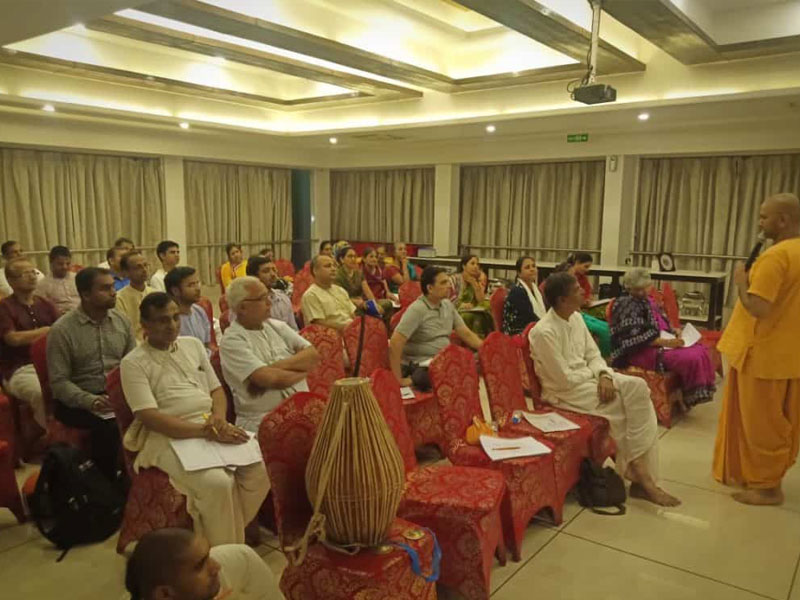
Drawing from his academic expertise and decades of practical management experience, Tamohara Dasa has developed comprehensive leadership training programs tailored for ISKCON's organizational needs. These programs address the unique challenges of leading spiritual communities โ where the metrics of success are not financial but spiritual, and where authority derives from character rather than title.
His leadership curriculum covers servant leadership principles derived from Srimad Bhagavatam, conflict resolution based on Vaishnava etiquette, emotional intelligence through the lens of the three modes of material nature (gunas), strategic planning informed by the concept of daivi-varnashrama, and communication skills rooted in sattvic speech (truthful, pleasing, and beneficial).
In an age where perception is shaped by media, Tamohara Dasa recognized early the critical importance of media literacy and strategic communication for ISKCON. His research in this field examines how religious organizations can engage with modern media landscapes authentically โ neither compromising their message for popularity nor retreating into insularity.
His work covers social media engagement strategies for temples, content creation frameworks for presenting Vedic philosophy to digital-native audiences, crisis communication protocols, and the psychology of online community building. He has particularly focused on how visual media and storytelling can convey the beauty and depth of Bhakti Yoga to audiences with no prior exposure to Indian spiritual traditions.
A body of work spanning decades, bridging empirical social science with the philosophical treasury of the Gaudiya Vaishnava tradition.
How devotees progress through stages of spiritual understanding โ from initial intellectual interest (shraddha) through deep realization (bhava) โ mapped against established cognitive development theories. This research provides ISKCON educators with evidence-based frameworks for designing more effective spiritual education programs.
An examination of motivation, commitment, and burnout in volunteer-driven religious organizations. His findings have directly influenced ISKCON's policies on devotee welfare, workload management, and the prevention of leadership burnout โ one of the movement's persistent challenges.
How the core concepts of Bhakti Yoga โ karma, reincarnation, devotion, surrender โ can be authentically communicated across cultural boundaries without distortion. This research has shaped ISKCON's preaching strategies in the American South, a region with strong Christian cultural identity.
"Research, when conducted in a spirit of devotion, becomes a form of sadhana. Every insight uncovered is a glimpse of Krishna's infinite intelligence operating through His creation. The scholar-devotee does not merely study the world โ he worships its Creator through the act of understanding."